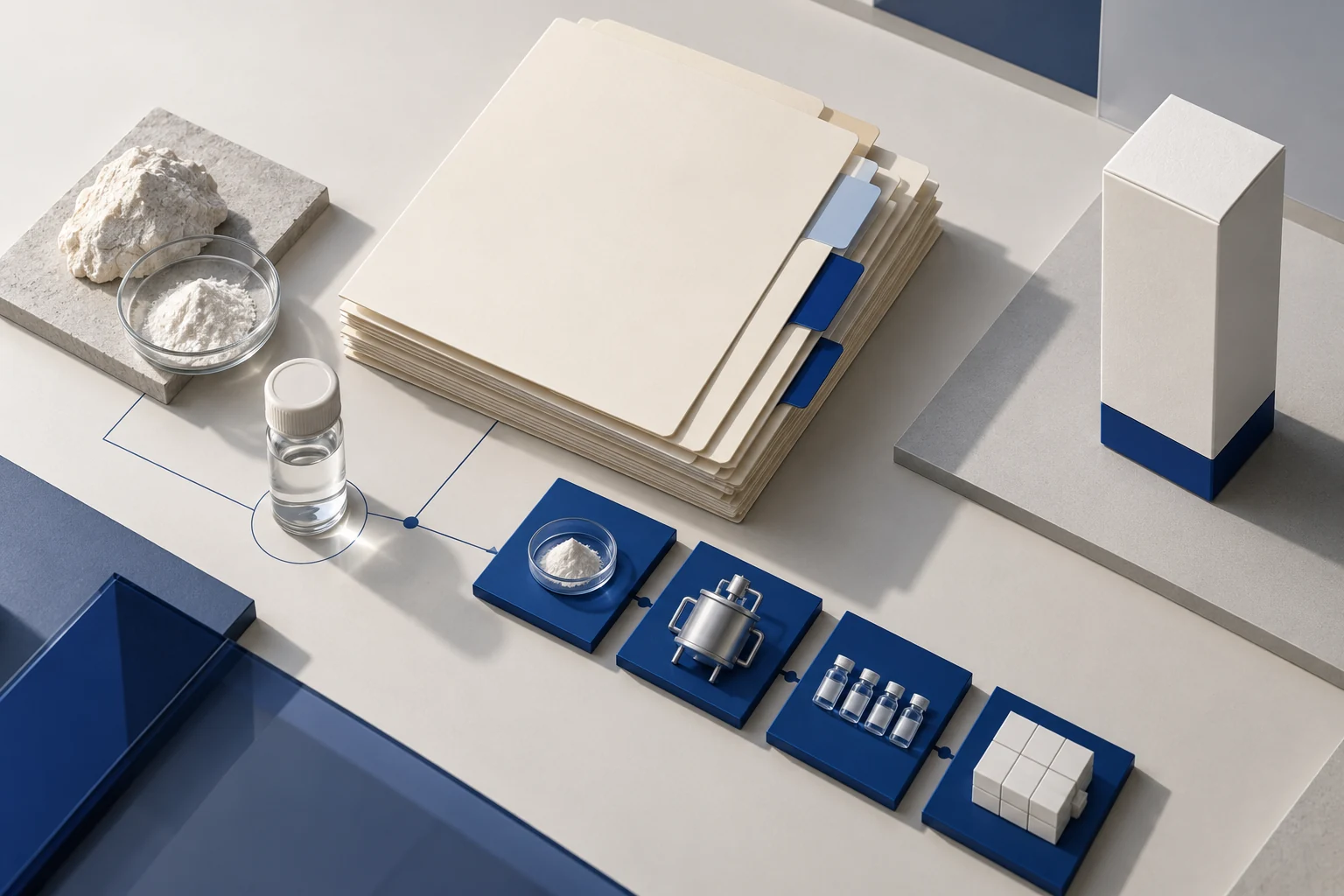
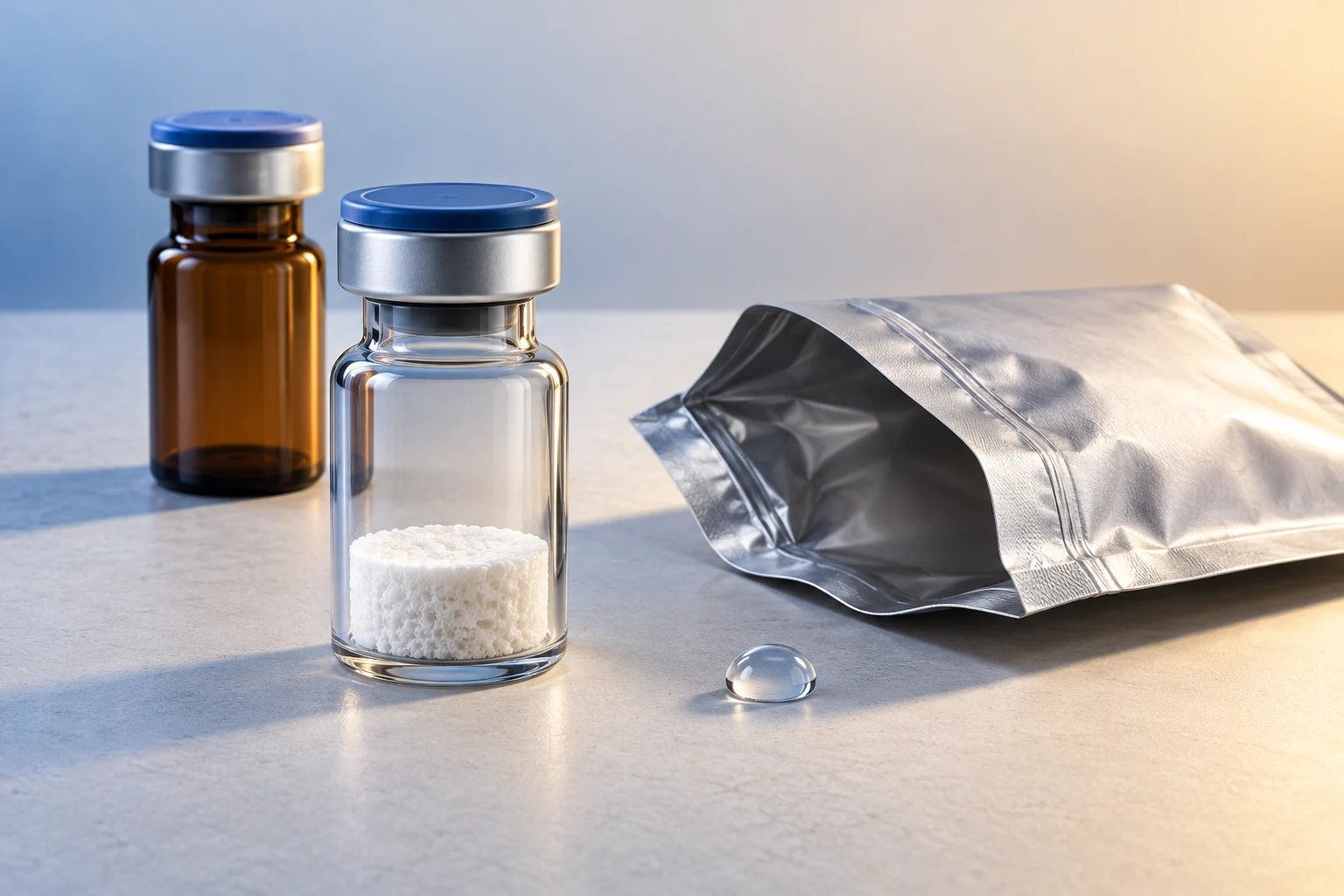
A defensible shelf life for lyophilized peptide powder depends on the specific formulation, container closure and storage conditions. A dry appearance cannot establish stability. Before accepting a storage statement, ask which batches, analytical attributes and packaged configurations support it.
“Freeze-dried” describes a manufacturing process. Purchasing and quality teams still need to agree what the material must retain during shipment and storage, how those properties will be measured, and which changes require reassessment.
What freeze-drying changes
Lyophilization involves freezing, primary drying by sublimation and secondary drying to remove additional bound or adsorbed moisture. The FDA's historical inspection guide describes these stages in the context of parenteral drug manufacturing. The physical distinction is useful here; the document does not establish a cosmetic powder's sterility, shelf life or storage instructions. [1]
For an OEM brief, specify whether the product is a neat peptide powder or a formulated cake containing other ingredients. Record fill quantity and package configuration as well. A result from one formulation or vial size should be treated as evidence for that tested configuration until a documented justification supports an extension.
Appearance is one observation
A photograph can document colour, collapse, shrinkage or visible particles. It cannot replace the chemical and physical measurements selected for release and stability. Give appearance its own acceptance description so that staff can compare retained samples without relying on “looks normal.”
Build the protocol around decisions
ISO/TR 18811:2018 provides a framework for cosmetic stability assessment and explicitly leaves manufacturers to justify suitable protocols. Its public scope does not prescribe one set of conditions or acceptance limits for all cosmetics. [2] The following worksheet is a proposed planning tool, not a prescribed test schedule.
| Decision | Define before testing | Record in the report |
|---|---|---|
| Material remains within specification | Relevant identity, assay and impurity methods with agreed limits | Individual results, method revision and any trend requiring review |
| Moisture is controlled | Suitable moisture method, such as a qualified Karl Fischer procedure | Sampling precautions, result basis and package configuration |
| Package remains suitable | Closure or seal checks appropriate to the pack | Closure components, test method and observed failures |
| Material can be handled as intended | Relevant appearance and dispersion or dissolution procedure | Defined medium and observation method, where applicable |
| Shipment is acceptable | Route assumptions, excursion review process and transport study needs | Actual exposure evidence and the basis for disposition |
Set sampling intervals and the number of batches through a documented, product-specific rationale. Preserve a time-zero result for comparison. Where a method changes during the programme, decide how the old and new data will be compared before adding them to the same trend chart.
Use accelerated conditions with their original context
ICH Q1A(R2), a guideline for new drug substances and products, lists 40 ± 2 °C and 75 ± 5% relative humidity for six months under its general accelerated condition. Those numbers are a pharmaceutical reference, not a ready-made cosmetic peptide storage recommendation. A result at that condition does not, on its own, establish a particular room-temperature shelf life. [3]
Use a protocol to explain what an accelerated study is intended to reveal and how it relates to the claimed storage condition. If the formulation or package behaves differently under severe exposure, investigate that difference instead of applying an unexplained conversion factor. A buyer should be able to trace the shelf-life statement to a signed assessment and the underlying observations.
Ask about excursions separately
A long-term storage study and a transport assessment answer different questions. State the expected route and duration in the enquiry. Ask who reviews an out-of-range temperature record and what evidence that person will use. A generic instruction to “keep cool” gives receiving staff no workable disposition rule.
Treat packaging as part of the tested product
Specify the vial or sachet material, closure components, seal process and secondary packaging. Record whether a desiccant is part of the configuration. When a pack supplier proposes a substitution, compare the actual material specification and relevant barrier or closure evidence, then decide what additional work is necessary.
For example, a hypothetical move from a crimped vial to a foil sachet changes the package being evaluated even if the powder formula stays constant. It should trigger a documented assessment of filling, sealing, handling and stability evidence. This example describes a review decision, not a claim that either pack is universally better.
The storage statement needs a usable handover
- Identify the formulation revision, tested batches and exact commercial pack.
- State the supported storage conditions and whether a date is an expiry or a retest date.
- Separate unopened storage evidence from any proposed opened-container or prepared-solution use period.
- Include receiving instructions and the contact responsible for excursion review.
- List changes that require notification, including formulation, drying process or closure changes.
Do not infer a prepared-solution holding time from dry-powder data. If a downstream process requires dissolution or blending, define that process separately and obtain the evidence relevant to it. The peptide CoA guide explains the difference between purity and content; the peptide development page provides the starting point for discussing a material-specific project.
Frequently asked questions
Does freeze-drying guarantee a longer shelf life?
The process alone cannot establish a shelf life. The storage statement needs supporting data for the specific formulation, commercial package and conditions.
Should every lyophilized peptide be stored at the same temperature?
No universal temperature follows from the word lyophilized. Follow the supported, product-specific storage instructions and clarify any missing conditions with the supplier.
Can accelerated data alone justify a two-year shelf life?
An accelerated result does not automatically convert into a specific shelf life. The protocol, observed trends and scientific justification must support the proposed storage period.
Does dry-powder stability cover a prepared solution?
No. A prepared solution introduces a different configuration and holding period. Obtain evidence for the intended preparation and downstream process separately.
References
- FDA (1993). Lyophilization of Parenteral (7/93). Historical inspection guide; pharmaceutical context.
- ISO/TR 18811:2018. Cosmetics: Guidelines on the stability testing of cosmetic products. Public scope.
- ICH Q1A(R2) (2003), published by EMA. Stability testing of new drug substances and products, section 2.2.7.1.
Sources checked 31 October 2026. Research findings are cited in their original context; they are not product-specific test results.