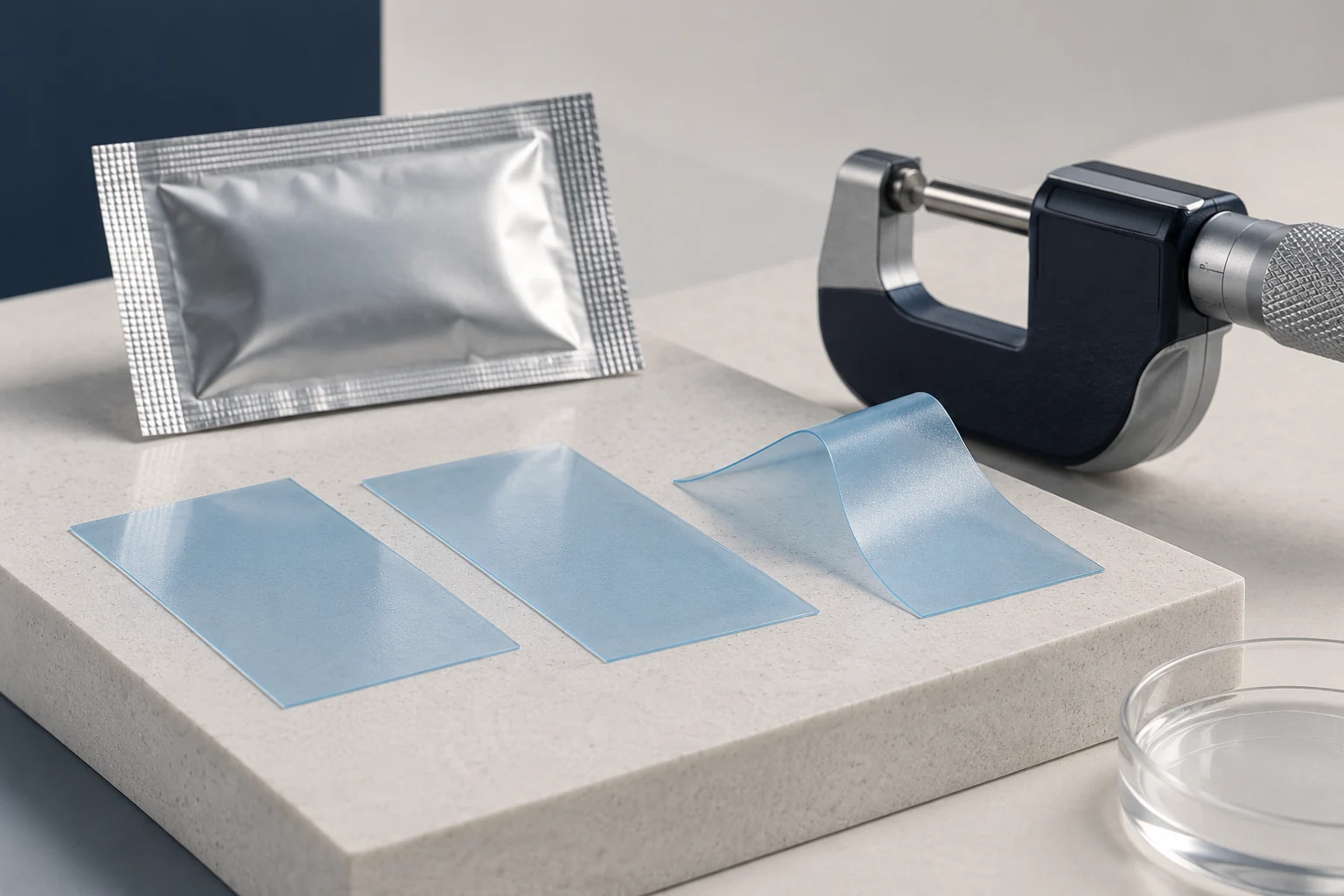
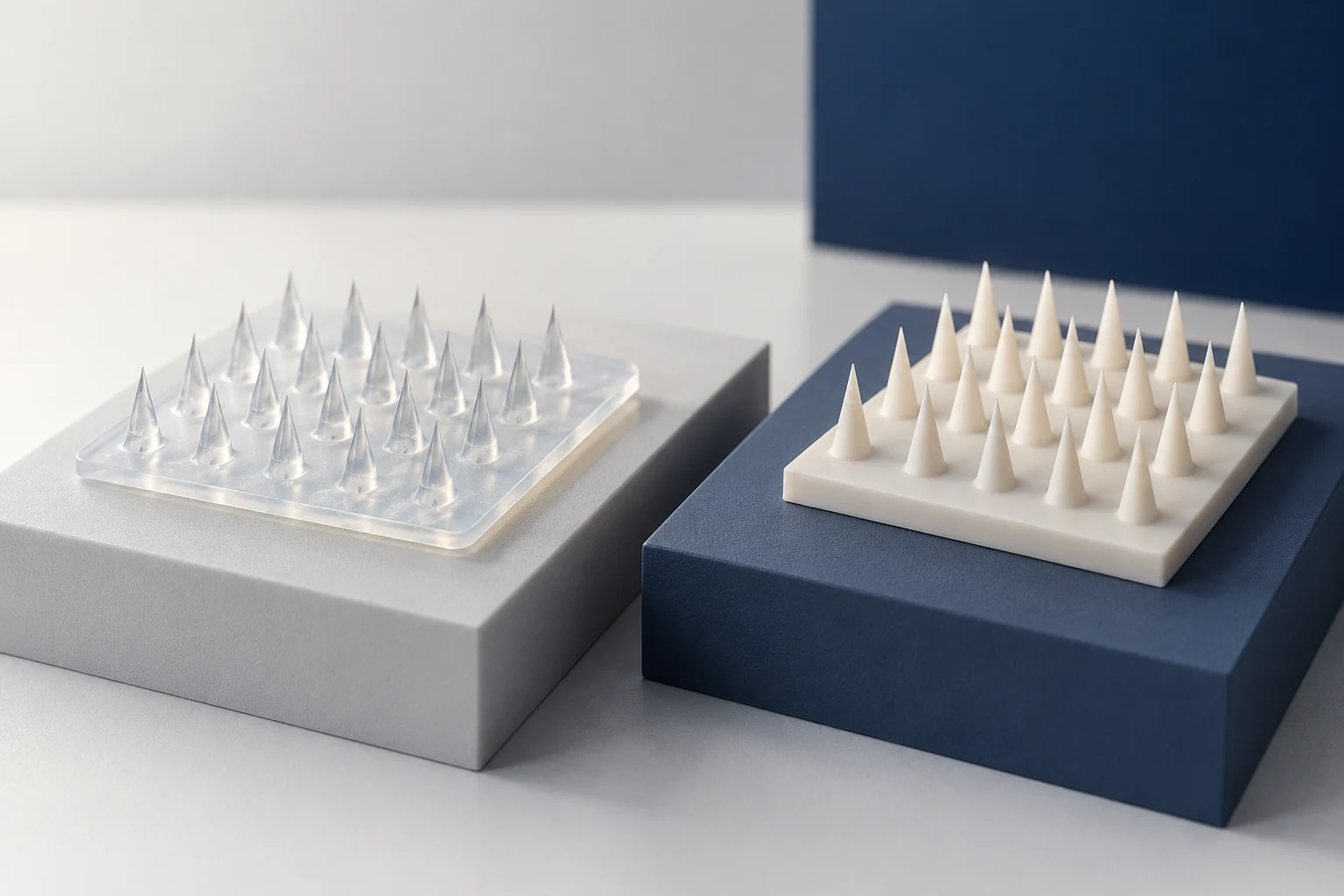
A dissolvable microneedle patch and a PLA-based solid microneedle device need different OEM specifications. The first is designed around a matrix that dissolves under defined conditions; the second requires a solid-structure specification and its own material and performance evidence. “Biodegradable” does not establish how quickly a device dissolves during use.
For a brand or development team, the choice starts with intended use, material composition and the evidence needed for the destination market. Needle count and patch size are useful drawing fields, but they cannot describe the entire product.
Separate material behaviour from device geometry
Lee, Park and Prausnitz investigated dissolving polymer microneedles alongside PLA structures in a laboratory study. Their work shows why geometry and material must be considered together when examining mechanical behaviour. It does not establish performance for a commercial Hytanbio patch. [1]
| Specification question | Dissolvable matrix | PLA solid structure |
|---|---|---|
| What is the needle made from? | Identify matrix ingredients, their grades and any incorporated ingredient | Identify PLA grade, relevant material properties and any coating |
| What behaviour is being claimed? | Define the dissolution observation and test conditions | Define solid-structure integrity and any separately supported degradation claim |
| Where is the ingredient located? | Distinguish needle region, backing layer and total patch | Describe any coating or other component separately from the PLA structure |
| What must be checked after testing? | Remaining structure, matrix behaviour and relevant ingredient recovery | Deformation, fracture and residual material under the agreed method |
| What is the release decision? | Agree dimensions, composition and relevant mechanical and dissolution controls | Agree dimensions, material identity and relevant structural controls |
This comparison is a specification-planning framework. It does not prescribe a clinical application method or imply that one platform is preferable for every project.
A drawing needs more than needle length
In the 2008 study, researchers examined designs including 600 µm pyramidal and 800 µm conical microneedles. Those are experimental dimensions, not recommended commercial settings. Their comparison illustrates why length alone cannot describe a structure: base dimensions, shape and material were also part of the analysis. [1]
Ask the manufacturer to provide a revision-controlled drawing with needle height, base geometry, tip description, pitch, array layout and backing dimensions. Add dimensional tolerances and a measurement method. A dimension without a sampling rule leaves uncertainty about whether it represents an individual needle, an array average or a mould design target.
Distinguish design dimensions from measured dimensions
Give mould drawings, prototype measurements and released-product measurements separate identifiers. If a prototype was photographed under magnification, retain a scale and the sampling location in the technical record. An attractive macro image belongs in a presentation; a measured drawing and inspection report belong in a specification review.
Ask what the mechanical test actually measured
An experimental study of polymer microneedle failure by axial force examined the relationship between geometry, material and failure behaviour. [2] A purchaser can use that distinction to ask more precise questions about a supplier's own test, without borrowing the paper's result as a product limit.
- Was the force applied to one needle or a whole array?
- What fixture, loading direction and displacement rate were used?
- How were samples conditioned before measurement?
- Was the endpoint deformation, fracture or a predefined displacement?
- How many samples were assessed, and were individual results retained?
State units and the result basis in the report. A whole-array force cannot be compared directly with a per-needle value when the loading and contact conditions differ. Likewise, a compression result should not silently stand in for insertion, dissolution or ingredient-delivery evidence.
Define dissolution without promising delivery
For a dissolvable patch project, the protocol should identify the medium or model, temperature, exposure period and visual or analytical endpoint. Specify whether the reported observation concerns the needles, the backing or both. If ingredient release is measured, define the sampling and analytical recovery procedure separately.
A buyer should be able to distinguish a needle changing shape, a matrix dissolving, an ingredient being released and an ingredient crossing a biological barrier. These are different study questions. Do not convert a demonstration video into an absorption percentage or a clinical-effect claim.
Resolve intended use before approving the OEM brief
The FDA's microneedling guidance explains that intended use and claims matter when determining whether a product is a medical device. The guidance covers the US context; other destinations need their own assessment. A material description such as PLA, or a cosmetic marketing label, is not by itself a market-authorization decision. [3]
- Write the intended use and proposed claims in plain language.
- Select the platform and identify the composition and controlled drawing.
- Agree the test questions, methods and acceptance criteria before pilot production.
- Define packaging and the stability evidence needed for that configuration.
- Assign responsibility for safety assessment, classification, labelling and market entry.
Hytanbio describes dissolvable microneedle and PLA-based solid microneedle capabilities on its facilities page. Send the proposed format, market and evidence requirements with an OEM / ODM enquiry. A capability statement begins that discussion; the approved project specification determines what will be manufactured and documented.
Frequently asked questions
Is a biodegradable PLA microneedle the same as a dissolvable microneedle?
No. Biodegradability does not establish dissolution during a specified use period. The material, device design and relevant test evidence must define the claimed behaviour.
Does a longer needle always make a better patch?
Length alone cannot establish suitability. Geometry, material, mechanical behaviour, intended use and the applicable evidence requirements must be considered together.
Can compression strength prove ingredient delivery?
No. Compression testing addresses a defined mechanical question. Insertion, matrix dissolution, ingredient release and transport across a barrier require their own evidence.
Does an ISO 13485 certificate authorize every microneedle product for sale?
No. A management-system certificate has a defined organizational and activity scope. Product classification and destination-market requirements must be assessed separately.
References
- Lee, Park and Prausnitz (2008). Dissolving Microneedles for Transdermal Drug Delivery. Biomaterials.
- Park and Prausnitz (2010). Analysis of Mechanical Failure of Polymer Microneedles by Axial Force. Journal of the Korean Physical Society.
- FDA (2020). Regulatory Considerations for Microneedling Products. Guidance for industry and FDA staff.
Sources checked 31 October 2026. Research findings are cited in their original context; they are not product-specific test results.