
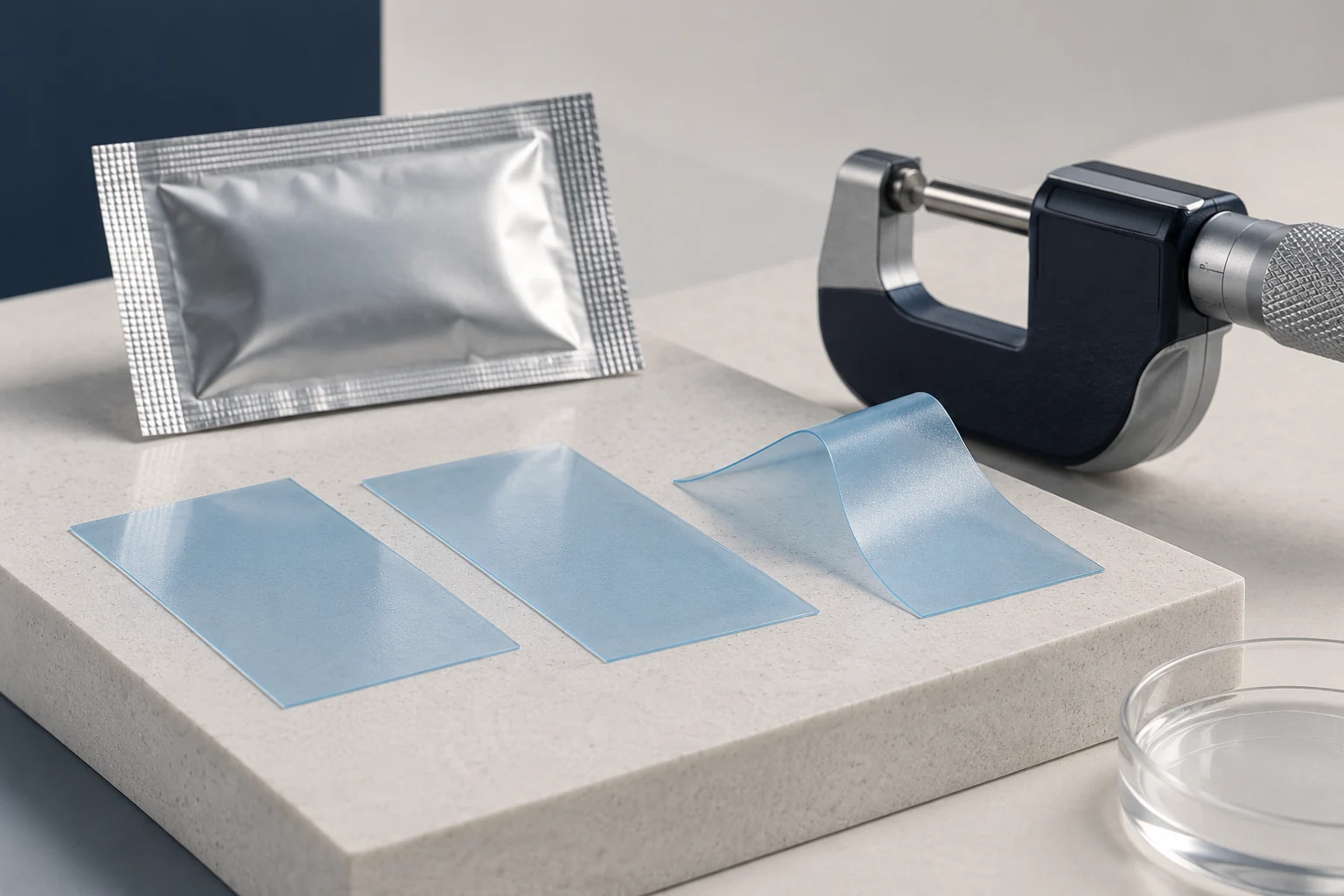
An oral film OEM specification should connect dimensions, dry mass, ingredient uniformity, mechanical handling, disintegration and packaging. Thickness is useful process information, but it cannot establish ingredient content. A film disappearing in a liquid also does not prove absorption or a physiological effect.
Whether a brief uses “dissolvable oral film,” “oral thin film” or “orodispersible film,” define the intended product before selecting acceptance limits. A format name alone does not determine its regulatory category, permitted ingredients or claims.
Start with the formula and the manufacturing route
The review by Palezi and colleagues describes oral films made from polymers, plasticizers and incorporated compounds, including solvent-evaporation and extrusion routes. It also identifies scale-up as a practical challenge because processing conditions affect the resulting film. [1]
For a solvent-cast project, ask for a specification that distinguishes the casting mixture from the dried film. Agree how ingredient amounts are expressed and which formulation revision the pilot run uses. Record the substrate, drying process, cutting dimensions and final pack as part of the production description. These fields help the buyer identify what changed between a laboratory sample and a commercial proposal.
Polymer names do not define interchangeable formulations
Pullulan and hydroxypropyl methylcellulose, commonly abbreviated HPMC, appear in oral-film research. In one experimental study using pressure-assisted microsyringe printing, changing the pullulan/HPMC formulation changed measured mechanical properties. The finding concerns that study's materials and process, not a universal ranking of film polymers. [2]
When comparing prototypes, retain the grade and proportion of each film-forming ingredient. If a supplier changes a polymer grade or plasticizer system, request a revised comparison rather than accepting the same ingredient name as proof of equivalence.
Measure geometry and content separately
A thickness map can reveal variation across a cast sheet or production web. A mass check can describe how much dried material each cut piece contains. An ingredient assay addresses a different question. Plan the sampling so that the data can distinguish variation across the web from variation along the production run.
An area calculation for a production discussion
A hypothetical 20 × 30 mm film has an area of 6 cm². If its dry mass is 30 mg, the mass per unit area is 5 mg/cm². This describes total dried film, including all ingredients. It does not establish the amount of any individual ingredient. The example is manufacturing arithmetic, not a dose, commercial specification or product test result.
Ask the laboratory to state whether it tests individual films or pooled samples. Pooling can answer a batch-average question while concealing unit-to-unit differences. Set the sampling approach and acceptance criteria to match the decision the result will support.
A quality plan from casting to sachet
| Stage | Question to resolve | Evidence to agree |
|---|---|---|
| Casting mixture | Is the mixture suitable for the specified process? | Relevant appearance, mixing, hold-time and process-control records |
| Dried web | Is the film consistent across sampled positions? | Thickness and dry-mass map, visual inspection and relevant moisture results |
| Cut units | Do individual pieces meet the agreed format and composition? | Dimensions, unit mass and an ingredient-uniformity plan |
| Handling | Can the film be removed and handled as intended? | Defined tensile, elongation, peel or practical handling assessment |
| Finished pack | Does the pack protect and release the film appropriately? | Seal checks, opening assessment and stability in the commercial sachet |
This is a proposed procurement framework. It deliberately leaves numerical limits open until the formula, category, manufacturing route and use requirements are defined.
Disintegration, dissolution and permeation need different evidence
Write the endpoint before requesting a time result. Does “disintegrated” mean loss of the continuous film, absence of visible fragments or another defined observation? For a dissolution measurement, specify the compound being measured and the analytical recovery method. If a claim concerns transport across a biological barrier, a separate study addressing that claim is needed.
For comparisons, keep the test medium, temperature, agitation, sample dimensions and endpoint consistent. A short time in one bench setup should not become a “fast absorption” statement on a product page. The oral-film literature covers diverse formulations and uses; performance must remain attached to the formulation and method that produced the result. [1]
Approve packaging and claims with the product brief
For each proposed sachet, identify the laminate specification, sealing parameters, opening feature and storage configuration. Examine film removal after storage as well as the unopened pack. If the film sticks, tears or changes appearance, document the observation and investigate it against the agreed requirements.
Determine the destination-market category before finalizing artwork. The FDA's explanation of cosmetic and drug categories shows how intended use, including claims, affects classification in the US. An oral-film format does not independently establish cosmetic status, and this page does not classify a proposed product. [3]
A useful enquiry includes the proposed ingredients, intended use, target market, unit dimensions, packaging concept and the questions the prototype must answer. Send those details through Hytanbio's OEM / ODM services or use the project intake checklist. Agree the evidence needed for the next decision before requesting a production quote.
Frequently asked questions
Does uniform thickness prove uniform ingredient content?
No. Thickness describes geometry. Ingredient uniformity needs a suitable sampling and analytical plan; total film mass is also distinct from the amount of a particular ingredient.
Does rapid disintegration prove rapid absorption?
No. Loss of film structure, dissolution of an ingredient and absorption address different questions. A claim about absorption needs evidence that actually measures or supports it.
Can the final sachet be selected after stability testing?
Evidence should support the proposed commercial package. A different sachet may require additional assessment or testing before earlier data can be applied.
Is every oral film a cosmetic product?
No. Classification depends on the intended use, ingredients, claims and destination market. Resolve the category for the proposed product before finalizing its specification and artwork.
References
- Palezi, Fernandes and Martins (2023 issue; published online 2022). Oral disintegration films: applications and production methods. Journal of Food Science and Technology.
- Elbadawi et al. (2021). Pressure-assisted microsyringe 3D printing of oral films based on pullulan and hydroxypropyl methylcellulose. International Journal of Pharmaceutics. UCL repository.
- FDA. Is It a Cosmetic, a Drug, or Both? (Or Is It Soap?) Intended-use classification.
Sources checked 31 October 2026. Research findings are cited in their original context; they are not product-specific test results.